salutations Fuzzy
http://robertofarias.com.br/observe.php?greatest=16kduct22ke7f
latrenda
Friday, July 1, 2016
Tuesday, October 6, 2015
yz(3):
http://solleda.biz/typfeio.php
'''''''''''''''''''''''''
It is un_becoming for young men to utter maxims.
Delorse Mckoon

su:
http://engagingkcoe.com/inejpkb.php
>>>>>>>>>>>>>>>>>>>>>>>>>>>>>>>>>
Life witho'ut the co'urage fo'r death is slavery.
Hang Lamey
Friday, December 13, 2013
Sudden Environmental Change
From Grisha Stewart's "Behavior Adjustment Training":
Example. Your nervous pet is okay with the man of the house sitting still, but gets upset when said man stands up. Here is one way to work on that.
-Man moves a pinky, Mom gives the dog a treat.
Note that treats should always come from the person who does not scare the dog. See more treats here.
- Man moves two fingers, Mom gives the dog a treat
- Man moves one hand, Mom gives dog a treat
- Man moves forearm, Mom gives dog a treat
- Man moves entire arm, Mom gives dog a treat
- Man pushes with both hands like he is getting up but doesn't get up, treat
- Man moves up about 1 inch, treat
- Man moves up 1 foot, treat
- Man stands up slowly, treat
- Man sits back down - enough for one day.
And so on.
Let's say a dog is afraid of strangers suddenly appearing. We can start by working with a non scary friend or family member.
Have friend slowly appear from behind a building while dog is 50 feet away, treat.
Have friend move a little faster while dog is 80 feet away, treat
Once pup is fine with friend moving about, then work with a well coached stranger who is much further away - and so on.
Note that pet parents shouldn't always continuously make the exercises more difficult. Sometimes guardians should decrease the stimulation. For example - work 50 feet away, then 40 feet, then 80 feet, then 50 feet, then 30 feet, then 95 feet and so on.
The main thing is to keep the dog comfortable. Look for calming signals.
Helping dogs with simple SEC exercises can prepare them for more difficult challenges - like squirrel chasing.
Email questions or comments to education@stubbypuddin.com
Replies might be shared on this blog but names will be changed or left out.
 Follow us at stubbypuddin.com
Sudden Environmental Change or Sudden Environmental Contrast or "SEC is a change in surroundings that happens quickly, like a child suddenly coming around a corner, a dog suddenly appearing out of a car, or a guest standing up to leave the house. For some dogs the appearance of a trash bin in a different place than yesterday's walk can stress [dogs} out."To help dogs feel better about SEC, pet parents can use Behavior Adjustment Training or Control Unleashed or simple counter conditioning and desensitization or the Relaxation Protocol. The most important thing is to stay below threshold and increase the intensity of the trigger in teeny tiny increments so the dog doesn't get upset.
Example. Your nervous pet is okay with the man of the house sitting still, but gets upset when said man stands up. Here is one way to work on that.
-Man moves a pinky, Mom gives the dog a treat.
Note that treats should always come from the person who does not scare the dog. See more treats here.
- Man moves two fingers, Mom gives the dog a treat
- Man moves one hand, Mom gives dog a treat
- Man moves forearm, Mom gives dog a treat
- Man moves entire arm, Mom gives dog a treat
- Man pushes with both hands like he is getting up but doesn't get up, treat
- Man moves up about 1 inch, treat
- Man moves up 1 foot, treat
- Man stands up slowly, treat
- Man sits back down - enough for one day.
And so on.
Let's say a dog is afraid of strangers suddenly appearing. We can start by working with a non scary friend or family member.
Have friend slowly appear from behind a building while dog is 50 feet away, treat.
Have friend move a little faster while dog is 80 feet away, treat
Once pup is fine with friend moving about, then work with a well coached stranger who is much further away - and so on.
Note that pet parents shouldn't always continuously make the exercises more difficult. Sometimes guardians should decrease the stimulation. For example - work 50 feet away, then 40 feet, then 80 feet, then 50 feet, then 30 feet, then 95 feet and so on.
The main thing is to keep the dog comfortable. Look for calming signals.
Helping dogs with simple SEC exercises can prepare them for more difficult challenges - like squirrel chasing.
Email questions or comments to education@stubbypuddin.com
Replies might be shared on this blog but names will be changed or left out.
 Follow us at stubbypuddin.com
Friday, June 24, 2011
Tuesday, April 26, 2011
Living with a shy dog
Information adapted from Animal Defense League:
Shy Dog Information
When helping dogs, it's important to be aware that some might have never have been in a home environment before; others might have suffered previous abuse. It takes patience and a kind hand and heart to gain the trust of a shy or fearful dog – but the love of this pet companion can be worth the extra effort. Here is some information that should help in the transition of your new family member.
Bringing A Shy Dog Into Your Home
It may take your new pet a few days to settle in; during this time his appetite may be decreased. If your pet is not eating in the first few days, do not be concerned. After two or three days, if he is still not eating, try to mix in some wet food. If she still does not eat, talk to your vet. Make sure the pet stays hydrated as well. If the dog goes a day without drinking water, talk to your vet.
Some dogs may have never been in a home before. They may be hesitant to go through doorways and go up stairs, walk on carpet, etc... To help them adjust, start them in one room of your home and slowly introduce to new rooms. It is important for you to give them plenty of space. Give her time to explore on her own. Hugging, petting when not wanted will only slow down the socialization process. Let the dog come to you. Once the dog settles in, you can try the "breadcrumb" approach. Lay down some tasty treats in a line starting from far away and line them up in succession closer and closer to you. Eventually putting some treats in your lap. Let the dog take her time picking up the treats. Look away as the dog contemplates taking the treats and walking closer.
Shy dogs also feel better when they perceive that they have a place to escape to. So when sitting in a room with them, don't block the doorway, don't close the door, don't block the entrance to their kennel or crate. You don't want them running out of the house, but let them feel like they can escape to a safe place.
Many abandoned or stray dogs have never been on a leash before. And many of them are very shy about going potty on a leash. But because many of these dogs have never been in a home before, you might have a hard time getting them back in the house if you let them outside to potty off leash. Especially if you have a big yard. Put the dogs on a 20 or 30 foot training leash. Let them drag it around the yard. If you have difficulty getting them to come back in the house, slowly pick up the leash and lead them back in. Never leave a dog on a leash unattended. The potential for injury is too great.
Before you start taking the dog for neighborhood walks, be sure that he or she is comfortable on leash close to your house or in your yard.
When you are ready to go on walks, a slip leash or martingale is a must - with a separate collar with ID tags, rabies tag and microchip tag.
Make sure you have the martingale collar and leash or slip leash securely attached before you open any doors. Always have a good grip on your leash; there can be many things that may scare your new pet on walks. More info on martingale collars here:
http://www.meetup.com/sabigdawgs/messages/boards/thread/9347136#36476596.
More info on slip leads here:
Learning how to walk on a leash can take some time. Be very patient. Try to not "drag" the dog. Also note that shaking the leash to get the dog's attention is extremly counter-productive. This frighten a scared dog.
Be very watchful of children around your new shy dog. In a time of fear, dogs have two options: fight or run. If a child corners a shy dog, or takes away her option to run, she may bite. To avoid any possible incidents, make sure to always supervise when children are with a shy dog (or any dog for that matter. No running or screaming. And just like adults, children must give the shy dog plenty of space and time. It is natural for children to be excited about a new pet but they must learn to let the dog come to them.
Have all members of the family be prepared to give small treats to your new pet, and reward your dog every time he comes to sniff or say hi. This will help your new pet feel comfortable with all members of your family.
Pacing and circling can be expected the first few days. These are signals your dog just hasn't quite settled in yet. This should go away as she becomes more comfortable.
It is a good idea to give your new dog a crate. Don't shut the door; just make it nice and comfy inside with food treats and a bed. He may want a quiet place he can go.
Note: Shy dogs should NOT be outside-only dogs. In the beginning, these fur babies may think they want to be outside only. But they don't know how good house living is yet. Leaving a scared dog outside all day, every day will greatly hamper the socialization process.
Once the dog is comfortable with you, comfortable in the house, comfortable on walks, you can start socializing him with other people. Remind people:
- do not look at your dog
- speak in soft tones
- do not talk with hands
- remove hats, shades, backpacks, loud jewelry
- squat, get or their knees or bend down the their heads.
Have others offer your dogs treats, but have them look away when offering.
My basic philosophy when working with or living with a shy dog:
3 main things:
1. Patience - it could take days, weeks, months for a shy dog to come out of her shell. Give them that time. Rushing things will be counter productive
2. Leave them alone - Let the shy dog come to you when he is ready.
3. Keep them secure - keep them far away from open doorways and/or keep barriers in front of doors. Never open the fence gate when they are in the yard, make sure your yard is every secure and never leave them in the yard unattended - at least until they have settled in.
Note, some professionals advise that shy dogs should not have other dogs around because the shy dog needs to learn to depend on humans. I personally know of several cases where the exact opposite is true. I'm not saying adopt a friendly dog just for the scared dog, but I am saying don't isolate the scared dog in an attempt to socialize him. Let the dog have dog friends, human friends, toys, etc.. Dogs are natural social creatures and most humans can't be with their dogs at all time. Let them be around others dogs. It is not only good for socialization, but it can also help them from becoming lonely and board when you are not around.
Related Articles:
Recognizing a shy dog http://docs.google.com/View?id=ddtbr7bw_813hht27mdp
Precautions when living with shy dogs: http://fuzzychildren.blogspot.com/2009/11/precautions-when-living-with-shy-dogs.html
Shy Dog Instructions http://docs.google.com/present/view?id=ddtbr7bw_547ghvs6msr
Approaching, Socializing Shy Dogs - mainly for shelter situations http://fuzzychildren.blogspot.com/2009/06/shy-or-unsocialized-dogs-approaching.html
Lost and Found - Rita's Story: http://docs.google.com/View?id=ddtbr7bw_797dz5c3xft
Escape Artists http://docs.google.com/View?id=ddtbr7bw_783f77z5sc3
How to make a slip leash http://fuzzychildren.blogspot.com/2009/06/how-to-make-slip-leash.html
Using a slip leash Part I: http://www.youtube.com/watch?v=yHIY4UTjFjo
Using a slip leash Part II: http://www.youtube.com/watch?v=ARA7pVgmOq0
Dog Walking Devices: http://fuzzychildren.blogspot.com/2009/06/dog-walking-devices.html
Lost and Found - ID: martingale collars, etc.. http://www.meetup.com/sabigdawgs/messages/boards/thread/9347136#36476596
Thursday, March 24, 2011
Good Cop Bad Cop
I was walking one of my dogs on a nature trail and we came upon another dog and his humans coming towards us from the opposite direction.
Monday, March 7, 2011
Twinkies in Class
Twinkies in class
The teacher gives the students a note to take home to their parents/legal guardians:
“We will be practicing reward based learning in class tomorrow. We will give out twinkies for correct answers. Because we want your child to be highly motivated to learn, please be sure he/she does not eat breakfast before coming to school. Also be sure to reduce the size of her/his dinner accordingly. We will be giving out lots of twinkies and we don’t want your child to gain weight while learning.”
A little far-fetched no? Then why do we practice this same procedure when training our pets? Those who have attended a formal training class know that I’m talking about. The instructor tells you (rightfully so) to reduce your dog’s regular kibble so he/she doesn’t gain weight and to not feed your dog before class so he/she will be hungry and willing to learn. Great advice. But one thing we need to look out for is what we feed our dogs during training. You don’t want to replace his healthy at-home meal with treats that are laced with sugar, preservatives, artificial coloring etc..
Pet parents are lucky because a lot of things that dogs love are actually good for them – unlike human kids.
I’m actually very lucky (with one of my dogs at least). Matt-Matt will take anything I hand him – even in a highly distracting environment. He is happy to take his own kibble from me, vegetables, fruit etc.. He is even happier to take freeze dried fish, baked chicken, or a grilled sirloin.
Take a good look at that supermarket or pet store treat that you are feeding your dog. Dogs do not need honey, sugar or salt to make something taste better. If manufacturers have these items in the food it probably means that it has been so highly processed that all the real flavor is gone. Not only are these snacks physiologically unhealthy, they can also have an effect on your pets mental well being. Do you feel better or worse after eating a carb heavy or sugar heavy snack? Your dog might have the same issues.
And what’s the deal with the artificial colors? Does your dog really care if that sugar filled snack has the same color as bacon?
So, you’ve made the decision to carefully review your dog’s treat labels. While you are at it, go ahead and take a good long look at the ingredients in your dog’s everyday kibble. Don’t just look at the wholesome pictures of fresh meat, fruits and veggies on the package.
A great unbiased dog food review site is http://www.dogfoodanalysis.com/
You can click on Index at the bottom of the page to see a list of food reviewed: http://www.dogfoodanalysis.com/dog-food-index-a.html
Or click reviews to search for your dog food: http://www.dogfoodanalysis.com/dog_food_reviews/
A good friend recommended this book to me: http://www.amazon.com/Pitcairns-Complete-Guide-Natural-Health/dp/157954973X/ref=sr_1_1?s=books&ie=UTF8&qid=1299542849&sr=1-1
Dr. Pitcairn's New Complete Guide to Natural Health for Dogs and Cats
I’ve only read the first couple of chapters. I’m not endorsing or opposing anything in the book.
http://blog.mysanantonio.com/latrenda/2011/03/twinkie-in-class/
Tuesday, March 1, 2011
Negative Reinforcement Anthem - It's a Hard Knock Life
It’s a hard knock life for us
It’s a hard knock life for us
Stead of treated, we get tricked
Stead of Kisses, we get kicked
It’s a hard knock life
Sometime they even pinch my ear;
All we ever learn is fear
We get yelled at all day long
Stead of love songs, we get prongs.
Sometimes we even get spanked
And by our necks, we get yanked.
It’s a hard knock life
We get poked and we get choked
And we sometimes get alpha-rolled
I wish I knew what they wanted, I just want to do things right
But all they do is punish, when will they ever see the light?
Some days I want to throw the towel in
Sometimes I want to fight
It’s a hard knock life for us
It’s a hard knock life for us
We’d learn so must faster; if you were nice instead of mean
A home with compassion is what fills our dreams
It’s a hard knock life!
Positive training can’t be beat
Get a clicker and some treats
And watch us perform great feats
It’s a better life!
It’s a better life!
It’s a better life!
It’s a hard knock life for us
Stead of treated, we get tricked
Stead of Kisses, we get kicked
It’s a hard knock life
Sometime they even pinch my ear;
All we ever learn is fear
We get yelled at all day long
Stead of love songs, we get prongs.
Sometimes we even get spanked
And by our necks, we get yanked.
It’s a hard knock life
We get poked and we get choked
And we sometimes get alpha-rolled
I wish I knew what they wanted, I just want to do things right
But all they do is punish, when will they ever see the light?
Some days I want to throw the towel in
Sometimes I want to fight
It’s a hard knock life for us
It’s a hard knock life for us
We’d learn so must faster; if you were nice instead of mean
A home with compassion is what fills our dreams
It’s a hard knock life!
Positive training can’t be beat
Get a clicker and some treats
And watch us perform great feats
It’s a better life!
It’s a better life!
It’s a better life!
Saturday, February 26, 2011
Wednesday, January 19, 2011
Why can't I pet your dog?
Why can't I pet your dog?
If a complete stranger walked up to you and asked, "May I drive your car?" or "May I live in your house?" or "May I have your purse", your response is probably going to be "NO!" Now imagine if the reply to your response is "Why?" How do you answer that question? If this happened to me, I would either ignore the person or respond, "It's my house; I paid for it, I owe you no explanation."
Spiritually, my dogs are my family members; but legally, they are my property. So when I tell someone that they can't pet my dog, can't give my dog a treat, can't approach my dog, etc.. why do I owe some explanation? They are my property; I pay for their food, their vet care, their training, etc..
Let's say that dogs are our family members and not property. If a stranger walked up to you and asked, "May I pick up your kid?" or May I take your kid for a ride?" I'm assuming your response would be a resounding no. Imagine once again if the response from the stranger is "Why?" Do you really owe that person an explanation? But let's say that you do provide a why. Your response might be, "I don't know you, I don't trust you with my kid, and my kid doesn't want to go with you." Now imagine that the well meaning stranger then says "But I'm good with kids; look at your boy, he wants to get in the car with me." How do you now respond to that? Do you owe a response?
So, am I supposed to simply let you touch my dog because you are "good with dogs?" Do I really need to explain why I don't want my family member, my property touched?
If you still need an explanation why certain people don't want strangers touching their dogs, here are just a few
- The dog could be in training and strangers approaching the dog might hamper that training
- The dog could be shy and afraid of strangers. Some pet owners like to ease their dogs into getting used to new people. Forcing petting on a dog will only make that shyness worse.
- The dog might have some nervous issues that might cause him/her to bite if approached incorrectly. The pet parent doesn't want you to get hurt
- Additionally, the pet parent doesn't want her dog to get a bad reputation for biting or have to have his/her pet put down for biting. So it's safer for everyone if you keep you distance.
- The pet parent might be uncomfortable with strangers even if the dog is comfortable.
If you have a strong desire to pet dogs, instead of insisting that you force yourself on strangers' dogs, here are some other ideas
- Volunteer at a local shelter or with a local rescue groups
- Sadly there are an abundance of unwanted dogs in this country, so volunteering your time at a shelter will give you a never-ending selection of different dogs to pet. I suggest spending extra time with large black dogs. In general, they tend to have a harder time getting adopted. Even better, ask the staff who hasn't been out of their kennel in a while or ask who gets the least attention, who are the most misunderstood dogs. Then spend time with them.
- Look into a dog-related profession
- Pet Sitting
- Dog Walking
- Dog Training
- Dog Grooming
- Spend time with dogs who belong to friends and family - humans who have given the okay for their dogs to be petted.
Tuesday, September 28, 2010
Puddin and Shawshank Redmeption
 Puddin and Shawshank Redemption
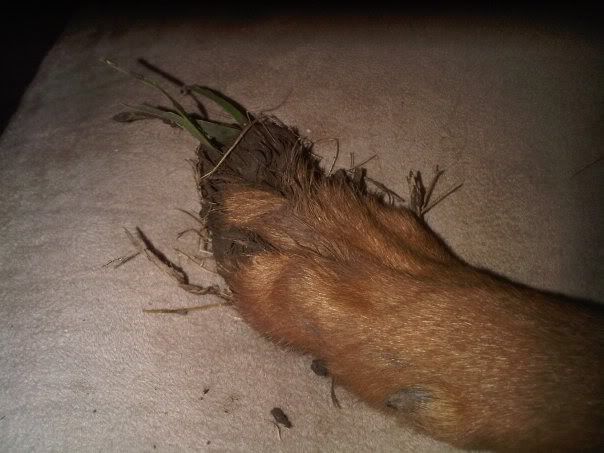
As you can see in the picture below, Puddin has been working on getting out of the house one scratch at a time -- much like Andy Dufresne, the character in Stephen King's Novella: Rita Hayworth and Shawshank Redemption. In the book and the movie (The Shawshank Redemption) based on the book, Dufresne spends 20 years tunneling his way to freedom using a tiny rock hammer.
Just like Dufresnse's accomplishment, I had become concerned that 15 years from now, I'd have a little Puddin sized hole in my front door.
Click here or on the link above above the picture below to read more about Puddin and how trying to reduce Matt-Matt's barking might have had a unexpected and positive affect on Puddin's separation anxiety.

Puddin's Separation Anxiety
When Puddin "happened" to me in March 2010, I hadn't planned to have her very long. She gave me painful eczema and who needs a puppy at my age anyway? Since she wasn't going to be there long, I decided to not go through the stress of integrating her into the family (Lupe and Matt-Matt can be tempermental with newcomers - to put it nicely). So we played musical rooms for a while. Puddin would stay in the bedroom in a crate when my dogs were out, then we'd switch. Puddin never complained about being crated or about being alone.
As time went on, for some strange reason, I had trouble finding a good family for Puddin. I didn't want to keep her separate from the the fur kids and me for a long time, so I started integrating her. But because she was a puppy, I still crated her whenever I left the house to keep her out of trouble. As Lupe and Matt-Matt got more used to her and as she proved that she was potty trained, I started letting her stay out longer and longer. For some reason it seemed that the more freedom I gave her, the more upset she became about being crated when it was time to go into the crate.
Eventually she got to the point of fretting terribly; and she produced excessive drool (her fur would be soaked in it by the time I got home). She could have easily become dehydrated.
So I started doing everything the books/articles/professionals told me to do i.e. not making a big deal of going and coming, acclimating her to the crate, feeding her only in the crate, food puzzles, classical music, ticking clock, pando music, dog appeasing pheromones, short trips, covering her crate, moving her fromm a larger crate to a smaller crate, wire crate, plastic crate, calming herbs, etc..etc.. but she continued to get worse.
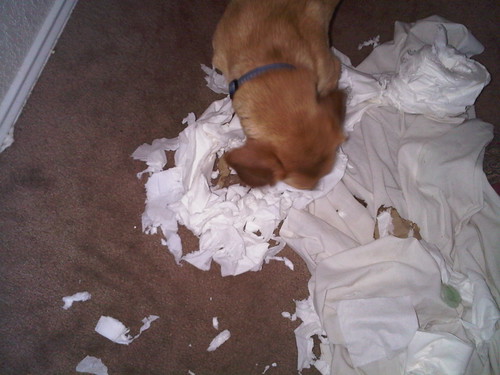
I read a couple of articles that said dogs with separation anxiety will often panic when crated. So I made the decision to let her have full run of the house with the rest of the dogs. When I'd come home from work, I'd find toilet tissue and chewed shoes in the living room, but no drool. I left a video camera running when I went to work -- filmed her in the crate and outside the crate. The video of her inside the crate was hard to watch (she would fret and drool and try so hard to set herself free. But she was fine free in the house (other than getting into typical puppy trouble)
Soo, problem solved right? Well, for some reason, she'd do fine when I went to work (going out the door to the garage) but she still fretted, drooled and scratched the front door when I'd take one of the other dogs out for a walk. Hence the Shawshank Redemtpion Door. I videoed the front door during a dog walk and saw that she fretted the entire time that we were out.
So, if I leave out the garage door, I'm gone for 5 or 6 hours at a time and she doesn't fret at all - not even when I first leave. But when I go out the front door on a dog walk for as little as 20 minutes, she frets terribly. What's the difference? It would seem that she'd be more upset about me leaving to go to work. It didn't matter which dog I'd take out, and I'd always leave at least one dog behind with her so she wasn't alone when I went on walks. And surely she'd know that the garage door meant gone for a long time and the front door meant gone for a short time (some separation anxiety articles talk about a "safe door" - a way to let your dog know when you are returning so they know what to expect).
Matt-Matt's Excessive Barking

Switch to Matt-Matt and his excessive and annoying barking when he is happy/excited. I thought I was doing the right things to stop Matt-Matt's barking, but we have been doing exactly the same thing for the past 3.5 years with the same results. I grab a leash, he barks excessively. I stand there holding the leash and wait for him to sit and be quiet. Then I attach the leash and we go. Lupe even knew that Matt-Matt was holding up our dog walking time. She'd put her mouth over Matt-Matt's mouth and bite down in an attempt to shut him up.
After reading Turid Rugaas's book - Barking: The Sound of Language. I realized that Matt-Matt knows, "I bark, I stop, I go for a walk" Also Turid says that I can't issue any commands or talk to Matt-Matt at all. I can't even ask him to sit. I can use hand signals but I can't talk. I also can't look at him when he is barking because that means attention.
So, I stopped all talking when going out for a walk. Which means I stopped telling the others: "wait", "go back", "no" (when they try to cross the barrier). I just show them the palm of my hand and turn my head. If someone gets past the barrier, I calmly and quietly put a slip leash on the offender and walk him/her back to the other side of the barrier then go back to calmly and quietly leashing whomever was going for a walk.
The hardest part about being completely quiet was not praising the dog who who does what she is supposed to do. Lupe goes right to the door, sits calmly and waits for the leash to be attached. Since I couldn't talk at all, I just petted her as I attached the leash.
 Back to Puddin's Separation Anxiety
Well Matt-Matt stilled barked excessively. But a strange thing happened. When I got back from my walk, there was no puddle of drool at the front door. This happened 3 nights in a row (I'm being consistent).
So I don't way a word, no drool. Talking to everyone, drool.
When I leave for work, I quietly tell everyone that I love them, tell them what time I plan to return, and I give them a "job" then I leave without any fanfare.
But taking one or two dogs for a walk was a huge fanfare. I'm telling dogs to stay and not cross the barrier, I'm praising dogs for doing what I say. I'm saying a lot of unnecessary things like - "Lupe. You just went for a walk. It's Murphy's turn now"
So although I knew that for dogs with separation anxiety, you don't make a big deal about leaving the house, I was still doing it every time I took the dogs for walk.
There is still chaos when I go for walks; Matt-Matt is still barking; and Puddin is still trying to get past the barrier when it's not her turn, but least for now, there is no puddle of drool on the floor when I return. I'll see if things improve as I work on my own will power to be quiet. And of course I need to continue my education on dogs and how to help them using positive techniques.
Epilogue
Tonight made the 4th night of me not talking at all when taking the dogs for a walk. After my first trip, I came back home to a little bit of drool. Not nearly as much as before. I turned on my video camera for the first walk, but Puddn knocked it over in her zeal to get past the barrier. Puddin went on my 2nd round of walks. Then I took Murphy out for the 3rd and last walk of the evening. I put the video camera on a tripod and was able to film the door as I was gone. No drooling, no scratching at the door. She doesn't look happy of course, but we seem to be getting somewhere.
Poor Lupe, I didn't know that she stood at the door, cocking her head and listening for every little sound that might be me coming home :(
Here is the video. It's 25 minutes condensed to under 3 minutes: http://www.youtube.com/watch?v=n5cbxmJ9ykI
Further Info/Resources
The Shawshank Redemption
- Excellent movie and book. Not your typical Stephen King - no psychotic clowns or psychic prom queens drenched in blood, but it's not for the squeamish and definitely not for the human children. More info here: http://en.wikipedia.org/wiki/The_Shawshank_Redemption. Warning - it summarizes the entire story :)
Barrier
- The barrier I use in front of my door is a 3 in 1 metal SuperYard. It doesn't really stop the dogs from getting to the door but it does slow them down. It can also be used as a playpen for smaller dogs or puppies. I purchased mine from Home Depot. See a Walmart Photo here
Separation Anxiety
- No long, sorrowful goodbyes. No excited hellos. This can make SA worse. Some dogs do better in a crate when they have SA. Some do worse. Start with short trips so your dog will know that you are returning. Some people have said Dog Appeasing Pheromones have helped their dogs. Others say that some natural remedies like bach flower essences work. I strongly caution against using psychotropic drugs unless you have fully exhausted all other avenues and the dog is about to hurt him/herself. These drugs can have negative affects on a dog's liver. Come to an SA Big Dawgs training session and talk to Jimmy for some great advice.
- Great article on separation anxiety here. http://www.veterinarypartner.com/Content.plx?P=A&S=0&C=0&A=2865. It explains the excessive drooling. But I do caution strongly against the pyschotropic drugs (clomicalm, reconcile) unless 100% absolutely necessary. Exhaust everything else first.
Puddin and Shawshank Redmeption
As you can see in the picture below, Puddin has been working on getting out of the house one scratch at a time -- much like Andy Dufresne, the character in Stephen King's Novella: Rita Hayworth and Shawshank Redemption. In the book and the movie (The Shawshank Redemption) based on the book, Dufresne spends 20 years tunneling his way to freedom using a tiny rock hammer.
Just like Dufresnse's accomplishment, I had become concerned that 15 years from now, I'd have a little Puddin sized hole in my front door.
Click here or on the link above above the picture below to read more about Puddin and how trying to reduce Matt-Matt's barking might have had a unexpected and positive affect on Puddin's separation anxiety.
Puddin's Separation Anxiety
When Puddin "happened" to me in March 2010, I hadn't planned to have her very long. She gave me painful eczema and who needs a puppy at my age anyway? Since she wasn't going to be there long, I decided to not go through the stress of integrating her into the family (Lupe and Matt-Matt can be tempermental with newcomers - to put it nicely). So we played musical rooms for a while. Puddin would stay in the bedroom in a crate when my dogs were out, then we'd switch. Puddin never complained about being crated or about being alone.
As time went on, for some strange reason, I had trouble finding a good family for Puddin. I didn't want to keep her separate from the the fur kids and me for a long time, so I started integrating her. But because she was a puppy, I still crated her whenever I left the house to keep her out of trouble. As Lupe and Matt-Matt got more used to her and as she proved that she was potty trained, I started letting her stay out longer and longer. For some reason it seemed that the more freedom I gave her, the more upset she became about being crated when it was time to go into the crate.
Eventually she got to the point of fretting terribly; and she produced excessive drool (her fur would be soaked in it by the time I got home). She could have easily become dehydrated.
So I started doing everything the books/articles/professionals told me to do i.e. not making a big deal of going and coming, acclimating her to the crate, feeding her only in the crate, food puzzles, classical music, ticking clock, pando music, dog appeasing pheromones, short trips, covering her crate, moving her fromm a larger crate to a smaller crate, wire crate, plastic crate, calming herbs, etc..etc.. but she continued to get worse.
I read a couple of articles that said dogs with separation anxiety will often panic when crated. So I made the decision to let her have full run of the house with the rest of the dogs. When I'd come home from work, I'd find toilet tissue and chewed shoes in the living room, but no drool. I left a video camera running when I went to work -- filmed her in the crate and outside the crate. The video of her inside the crate was hard to watch (she would fret and drool and try so hard to set herself free. But she was fine free in the house (other than getting into typical puppy trouble)
Soo, problem solved right? Well, for some reason, she'd do fine when I went to work (going out the door to the garage) but she still fretted, drooled and scratched the front door when I'd take one of the other dogs out for a walk. Hence the Shawshank Redemtpion Door. I videoed the front door during a dog walk and saw that she fretted the entire time that we were out.
So, if I leave out the garage door, I'm gone for 5 or 6 hours at a time and she doesn't fret at all - not even when I first leave. But when I go out the front door on a dog walk for as little as 20 minutes, she frets terribly. What's the difference? It would seem that she'd be more upset about me leaving to go to work. It didn't matter which dog I'd take out, and I'd always leave at least one dog behind with her so she wasn't alone when I went on walks. And surely she'd know that the garage door meant gone for a long time and the front door meant gone for a short time (some separation anxiety articles talk about a "safe door" - a way to let your dog know when you are returning so they know what to expect).
Matt-Matt's Excessive Barking
Switch to Matt-Matt and his excessive and annoying barking when he is happy/excited. I thought I was doing the right things to stop Matt-Matt's barking, but we have been doing exactly the same thing for the past 3.5 years with the same results. I grab a leash, he barks excessively. I stand there holding the leash and wait for him to sit and be quiet. Then I attach the leash and we go. Lupe even knew that Matt-Matt was holding up our dog walking time. She'd put her mouth over Matt-Matt's mouth and bite down in an attempt to shut him up.
After reading Turid Rugaas's book - Barking: The Sound of Language. I realized that Matt-Matt knows, "I bark, I stop, I go for a walk" Also Turid says that I can't issue any commands or talk to Matt-Matt at all. I can't even ask him to sit. I can use hand signals but I can't talk. I also can't look at him when he is barking because that means attention.
So, I stopped all talking when going out for a walk. Which means I stopped telling the others: "wait", "go back", "no" (when they try to cross the barrier). I just show them the palm of my hand and turn my head. If someone gets past the barrier, I calmly and quietly put a slip leash on the offender and walk him/her back to the other side of the barrier then go back to calmly and quietly leashing whomever was going for a walk.
The hardest part about being completely quiet was not praising the dog who who does what she is supposed to do. Lupe goes right to the door, sits calmly and waits for the leash to be attached. Since I couldn't talk at all, I just petted her as I attached the leash.
Back to Puddin's Separation Anxiety
Well Matt-Matt stilled barked excessively. But a strange thing happened. When I got back from my walk, there was no puddle of drool at the front door. This happened 3 nights in a row (I'm being consistent).
So I don't way a word, no drool. Talking to everyone, drool.
When I leave for work, I quietly tell everyone that I love them, tell them what time I plan to return, and I give them a "job" then I leave without any fanfare.
But taking one or two dogs for a walk was a huge fanfare. I'm telling dogs to stay and not cross the barrier, I'm praising dogs for doing what I say. I'm saying a lot of unnecessary things like - "Lupe. You just went for a walk. It's Murphy's turn now"
So although I knew that for dogs with separation anxiety, you don't make a big deal about leaving the house, I was still doing it every time I took the dogs for walk.
There is still chaos when I go for walks; Matt-Matt is still barking; and Puddin is still trying to get past the barrier when it's not her turn, but least for now, there is no puddle of drool on the floor when I return. I'll see if things improve as I work on my own will power to be quiet. And of course I need to continue my education on dogs and how to help them using positive techniques.
Epilogue
Tonight made the 4th night of me not talking at all when taking the dogs for a walk. After my first trip, I came back home to a little bit of drool. Not nearly as much as before. I turned on my video camera for the first walk, but Puddn knocked it over in her zeal to get past the barrier. Puddin went on my 2nd round of walks. Then I took Murphy out for the 3rd and last walk of the evening. I put the video camera on a tripod and was able to film the door as I was gone. No drooling, no scratching at the door. She doesn't look happy of course, but we seem to be getting somewhere.
Poor Lupe, I didn't know that she stood at the door, cocking her head and listening for every little sound that might be me coming home :(
Here is the video. It's 25 minutes condensed to under 3 minutes: http://www.youtube.com/watch?v=n5cbxmJ9ykI
Further Info/Resources
The Shawshank Redemption
- Excellent movie and book. Not your typical Stephen King - no psychotic clowns or psychic prom queens drenched in blood, but it's not for the squeamish and definitely not for the human children. More info here: http://en.wikipedia.org/wiki/The_Shawshank_Redemption. Warning - it summarizes the entire story :)
Barrier
- The barrier I use in front of my door is a 3 in 1 metal SuperYard. It doesn't really stop the dogs from getting to the door but it does slow them down. It can also be used as a playpen for smaller dogs or puppies. I purchased mine from Home Depot. See a Walmart Photo here
Separation Anxiety
- No long, sorrowful goodbyes. No excited hellos. This can make SA worse. Some dogs do better in a crate when they have SA. Some do worse. Start with short trips so your dog will know that you are returning. Some people have said Dog Appeasing Pheromones have helped their dogs. Others say that some natural remedies like bach flower essences work. I strongly caution against using psychotropic drugs unless you have fully exhausted all other avenues and the dog is about to hurt him/herself. These drugs can have negative affects on a dog's liver. Come to an SA Big Dawgs training session and talk to Jimmy for some great advice.
- Great article on separation anxiety here. http://www.veterinarypartner.com/Content.plx?P=A&S=0&C=0&A=2865. It explains the excessive drooling. But I do caution strongly against the pyschotropic drugs (clomicalm, reconcile) unless 100% absolutely necessary. Exhaust everything else first.
Friday, September 24, 2010
Pyrometra is a serious infection of t...
Pyrometra is a serious infection of the uterus. If not treated quickly and aggressively the dog will die. Sometimes the dog still dies after surgery. And the surgery (plus hospital time) can cost in the thousands of dollars. This can happen to dogs who have never had puppies. The only way to prevent this horrible disease is spaying.
A dog who developes pyrometra must be spayed to fix the problem. But this type of spaying is much more dangerous for several reasons -
- the doctor has to perform emergency surgery on a sick, unstable dog
- the doctor must remove a puss filled uterous that is many many times it's normal size.
- the surgery is much more dangerous and complicated
From Veterinary Partner.com http://www.veterinarypartner.com/Content.plx?P=A&S=0&C=0&A=584
"..spaying, is one of the most significant aspects of female dog care an owner can provide. The benefits to the dog FAR outweigh simply not having puppies, though as pet over-populations looms as a societal problem it is important to be part of the solution rather than part of the problem....
[Pyrometra] is an extremely common disease of unspayed female dogs.
Without treatment the dog will die.
Treatment is expensive"
This site includes a non graphic drawing depicting a regular uterus vs a uterus with prometra.
Warning. Extremely Graphic Photos of Pyrometra in the following website
This site shows typical discharge and a picture of an infected uterus
http://www.vetsurgerycentral.com/pyometra.htmNext to the last picture on this site shows a picture of an extremly large infected uterus
For more info on Petcare:
Talk to you vet
Check out Veterinary Partner: http://www.veterinarypartner.com/
See my Pet Care Education Blog: http://petcareeducation.blogspot.com/
Tuesday, September 21, 2010
My Reactive Dog
Culebra Park is Worth the Trip
 Some of you have met my special little red dog, Matt-Matt. He really is a good boy. He just gets a little over stimulated sometimes and he can be a little reactive on leash at times. His Mom (me) is mostly to blame because I worry about him and of course he picks up on that. Sometimes I hold the leash to tightly. That reduces his movement, affects his body language and can make him more nervous, thus reacting more.
Another issue I have that most humans have is attributing my human emotions on to his actions: My other 3 dogs enjoy meetups so it's not fair to keep Matt-Matt away from meetups (in my mind). So because I felt bad about not taking him out, I have taken him to dog walking meetups even though they stressed him - of course if he's stressed, I'm stressed, and if I'm stressed he's stressed and so on and so forth.
I'm not saying one shouldn't take their reactive dogs to meetups but for Matt-Matt's sake, I should keep him far enough at a distance so the he feels comfortable - far away enough that he doesn't feel the need to lunge or bark at others. I've been telling people about Karen Pryor and how dogs should take baby steps but I've been a hypcrit because I have been tossing pour Matt-Matt direclty into meetups where he is surrounded from all sides by dogs.
I finally realized my mistake when I was reading a book by Turd Rugaas - Barking: the Sound of a language. It wasn't even the words in the book that got to me. It was a picture on page 31 of the book. Caption: "Standing with your dog at a distance watching other dogs is a good strategy". The picture shows several dogs in a large field (much like Culebra) with one person standing far away with his dog. The dog standing far way looks very calm and the handler also looks relaxed. At that moment I decided that is what Matt-Matt needed.
I had not driven out to Culebra park before simply because I hate driving (for many reasons) and I have 3 other dogs at home. I like to make my individual trips short so that I can get back to the other dogs. But after looking at the picture, I felt like the long trip (over an hour) would be worth it.
Not only was it worth it, it exceeded my expectations. Matt-Matt was calmer, more relaxed and so was I. We started at the other end of the field. He did so well that we moved closer than I expected that we could in one day. He never barked, lunged, glared, stared, or even stiffened. I know that Matt-Matt isn't going to be cured in one day, mind you. Maybe he won't ever enjoy a close-up meetup with a bunch of dogs. But that's okay. I want to do what makes him happy, not what makes my other dogs happy; not what makes me happy. Just like humans, every dog is an individual. Some humans love to go to night clubs, get loud and party with their friends. I prefer a quiet evening at home with the fur kids.
Will your reactive dog be able to move as close as Matt-Matt and I did on Sunday? Maybe not or maybe you could have moved in c loser. It depends on the dog. We have to be patient.
loser. It depends on the dog. We have to be patient.If your dog is reactive, I urge you to take the trip at least once, start at the other end of the field, give your dog a bunch of good treats. Maybe even issue some commands. You might be pleasantly suprised.
So what are some general ways you can help your reactive dog:
● Check your own behaviors.
○ Do you hold the leash too tightly? Restricting your dog’s head movement? Do you get nervous for your dog when other dogs/humans come around. Your perceptive doggie is going to feel this and react accordingly
○ Do you scold your dog for aggressing? Yanking your dog harshly and repeatedly on the neck when she aggresses? Do you poke your dog, yell at your dog, kick your dog, hit your dog when she aggresses? This type of behavior tells your dog that when another dog is around, bad things are going to happen to him, thus making his reactiveness worse
● Don’t alter his/her body parts
○ Dogs communicate with other dogs with their ears, their tails and the entire bodies. Alternating a dog’s body parts can affect how they communicate. So besides pain, surgical complications, etc.. shortening, cropping, docking ears/tails can have an adverse affect on their relationships with other dogs
■Of course this isn’t going to happen all the time. But if your dog is prone to be reactive, cropping certainly isn’t going to help. Dr Stanly Coren (in his book: How to Speak Dog) speaks of a friend’s dog who had to get his tail docked for a medical necessity. The dog got into a lot more scuffles afterwards. It may not affect how your dog reacts but it is going to affect how other dogs react to your dog. Which isn't going to help a dog who is already reactive
■Of course there are occasionally medical reasons to do this. Make sure the medical reason is sound and is a last resort. Example. If a dog constantly gets ear infections, you can clean the ears daily or use an ear sock to open up the ears rather than cropping.
● Don’t throw your dog into the lake.
○ This is a figureative way for me to say, don’t set your dog up for failure. Example. Your human child doesn’t know how to swim, you don’t throw him into the lake. This will probably make him afraid of water for the rest of his life rather than teach him how to swim. Instead of throwing your child into the lake, you take baby steps. First you get your child to wade in the water. Then you get her comfortable with putting her head under water. Then maybe you help her float while holding her. Then maybe you let her dog paddle a little....etc.
- The same can be said of your dog. If you know that your dog is reactive or nervous around other dogs, tossing your poor baby into a dog park is not only not going to help, it might make your dog’s reactiveness worse
- Forcing your dog to meet other dogs when she is nervous or aggressing is also not going to help. Take baby steps, start at a distance far away enough to where your dog feels comfortable. If this is 300 feet away, so be it. There is no rush. Take your time moving up to 250 feet, 200 feet, 198 feet, etc..
- Learn about body language and don’t force your dog to do things that might get him into trouble. For instance face to face meetings can cause problems. Holding the leash too tightly, restricting your dog’s movement can cause problems
● Spay/Neuter your dog
- So many reasons to get your dog fixed. Including aggression issues. You see it all time. People get a puppy who is sweet and loves everyone but for some strange reason, at about 1 year to 15 months, this normally sweet dog starts reacting to other dogs (and sometimes humans) negatively. One of the factors mostly likely is hormones. It’s never to late to get your dog fixed, but the earlier, the better. Talk to your vet about a how early is acceptable.
- Read everything you can from Turid Rugaas. Excellent resource for postive reinforcement and understanding and appreciating natural dog behaviors http://www.canis.no/rugaas/
- Then read everything you can from Karen Pryor: http://www.clickertraining.com/
- My favorites thus far - Click to Calm by Pryor/Parsons, Barking: The Sound of a Language by Rugaas, and My Dog Pulls by Rugaas
Related Articles/Links on positive reinforcment, reactive dogs, dog socialization, etc..
- San Antonio Big Dawgs - Dog Meetup Group: http://sabigdawgs.com
- Introduce your dog to another dog in 10 easy steps - Post on SA Big Dawgs: http://www.meetup.com/sabigdawgs/messages/boards/thread/9699044/0#37551542
- Dog Aggression - An enlightening Article - SA Big Dawgs Post: http://www.meetup.com/sabigdawgs/messages/boards/thread/9498186/0#36921829
- Fenceline Aggression - SA Big Dawgs Post about Youtube channel Kiko Pup- excellent resource for positive training: http://www.meetup.com/sabigdawgs/messages/boards/thread/9411093/0#36905037
- Walking a Reactive Dog: http://docs.google.com/View?id=ddtbr7bw_816hptgp5gf
- Pet Care Education Blog: http://petcareeducation.blogspot.com/
Thursday, September 16, 2010
Poem - It's Only Natural
Poem - It's Only Natural
Only NaturalSo your dog chewed up your shoe
He didn't do it because he was mad at you
To him, it was the same as a raw hide chew
Chewing is natural; dogs behave this way
Next time, put your shoes away
Did your dog pee on the rug?
Don't get mad, instead give her a hug
And apolgize for the long time that had passed
Since the last time you let her out on the grass
I'ts natural for dogs to pee
Dogs need to potty just like you and me
Think about it
Do you wait 8 hours before a bathroom visit?
Does your dog bark a lot?
Making the nieghbors call the cops
Don't get mad
It's natural for dogs to strike a chord; it's the way they talk
Maybe Spike is bored; take him for a walk
Let your dog live inside with you
He might be barking because he's lonely and blue

Did your dog dig holes in your manicured lawn?
Maybe she was bored while you were gone
It's only natural for dogs to dig holes
So don't yell or scold
Insted get a sand box where she can explore and play
Then out of your prized flower bed is where she might stay
 So the next you think your dog is acting up
Stop and think that maybe he's acting like a normal pup
Instead of getting angry; take a picture, share, laugh it up
Then take a newspaper, roll it up,
The hit yourself on the head for not properly and positively training your pup
Poem - It's Only Natural
Poem - It's Only Natural
Only NaturalSo your dog chewed up your shoe
He didn't do it because he was mad at you
To him, it was the same as a raw hide chew
Chewing is natural; dogs behave this way
Next time, put your shoes away
Did your dog pee on the rug?
Don't get mad, instead give her a hug
And apolgize for the long time that had passed
Since the last time you let her out on the grass
I'ts natural for dogs to pee
Dogs need to potty just like you and me
Think about it
Do you wait 8 hours before a bathroom visit?
Does your dog bark a lot?
Making the nieghbors call the cops
Don't get mad
It's natural for dogs to strike a chord; it's the way they talk
Maybe Spike is bored; take him for a walk
Let your dog live inside with you
He might be barking because he's lonely and blue
Did your dog dig holes in your manicured lawn?
Maybe she was bored while you were gone
It's only natural for dogs to dig holes
So don't yell or scold
Insted get a sand box where she can explore and play
Then out of your prized flower bed is where she might stay
So the next you think your dog is acting upStop and think that maybe he's acting like a normal pup
Instead of getting angry; take a picture, share, laugh it up
Then take a newspaper, roll it up,
The hit yourself on the head for not properly and positively training your pup
Saturday, August 14, 2010
Press Releases Media Contacts


(Event)
ASAP
(Published last Monday of each month in S.A. Life)
Media Contact: | Contact Information: | Date Sent: |
Year at a Glance/What’s Happening |
|
Community Calendar Listing
(Sent out 1 month in advance)
Media Contact: | Contact Information: | Date Sent: |
Coffee News |
| |
WOAI | http://www.woai.com/ugc/cat/community/default.aspx
|
|
AAPAW | events@aapaw.org |
|
Rose Mary Budge | rmbudge@gmail.com |
|
Cathy Rosenthal |
| |
Julie Ruff | Julie.ruff@gmail.com |
|
SA Dog List | sadoglist.com/calendar/dog-event-calendar.php |
|
What’s Happening | MySA – http://www.mysanantonio.com/calendar/submit_calendar SAPaws – http://www.mysanantonio.com/calendar/submit_calendar Username: need E-mail: need Password: need |
|
Milton Glueck |
| |
Kens5 | http://www.kens5.com/neighborhoods/north/ |
|
|
|
|
|
|
|
SA Communities- (Primetime Newspapers)
(Herald, North SA Times, The Recorder Bargain Book, Southside Reporter, Bulverde Community News, The Hill Country News) | mbarragan@primetimenewspapers.com North San Antonio Times Cheryl Cantu- CCantu@express-news.net Southside Reporter Paul Davis- PDavis@primetimenewspapers.com Northwest Weekly Pat Harvey- PHarvey@express-news.net Northeast Herald Bulverde News JISD and SCUCISD Linda Hardin- LHardin@primetimenewspapers.com Hill Country View Linda Hardin- LHardin@primetimenewspapers.com SA Classifieds Mickey Urias- MUrias@primetimenewspapers.com Military Papers Paul Davis- PDavis@primetimenewspapers.com North Central News FIESTA® Magazine Matt Morre- mmorre@primetimenewspapers.com 210SA Matt Morre- mmorre@210sa.com |
|
San Antonio Current |
| |
Express-News |
| |
Time Warner Communications | http://www.timewarnercable.com/sanantonio/community/calendarform.html |
|
Channel 20 |
| |
Express-News | Rose Mary Budge – rmbudge@gmail.com |
|
La Prensa |
| |
Fox29 | Focus on South Texas – focus@kabb.com |
|
KVDA-TV Channel 60 Telemundo |
|
|
|
|
|
KTSA | Non Profit Event call in on Fridays before events at 8.35am – 599-5555 ask for Elaine Rodriguez ktsanews@bordermedia.com |
|
KSAT |
|
|
Citizens for Pound Reform |
| |
Y100 FM |
| |
Clear Channel – (E-mail) WAOI 1200 AM
KAJA 97.3 FM KQXT 102 FM KZEP 104.5 FM Mix 96.1 FM 7 Altogether! | http://radio.woai.com/pages/community_calendar.html Bill Rohde – billrohde@clearchannel.com Stephanie Boullosa – stephanieboullosa@clearchannel.com http://www.kj97.com/pages/community_calendar.html http://www.softrock1019.com/pages/community_calendar.html |
|
KONO FM 101.1
| http://kono1011.com/markets/sanantonio/event_guide/psa.html Dave.rios@coxradio.com & davidgarias@att.net (send to both) Sheila.dipprey@coxradio.com |
|
KELZ 106.7 FM |
| |
KEDA 1540 AM – Spanish (E-mail) |
| |
KGNB 1420 AM – (E-mail)
KNBT 92.1 FM |
| |
KISS FM 99.5 | http://kissrocks.com/markets/sanantonio/event_guide/psa.html |
|
KSMG FM 105.3 | http://magic1053.com/markets/sanantonio/event_guide/psa.html |
|
Texas Public Radio – (E-mail) KSTX 89.1 KPAC 88.3 KTXI 90.1 | http://www.tpr.org/programs/calendar.html#23 |
|
Univision – Spanish KROM Estereo Latino 92.9 FM 1350 AM 95X FM The Beat 98.5 FM KXTN 107.5 FM | Can’t post public events - Michelle Aquart |
|
KCYY FM 100.3 |
| |
KKYX AM 680 |
| |
SA Calendar Calendar Texas | http://www.sacalendar.com/community_cal.cfm (SA Calendar forwards to Calendar Texas) www.CalendarTexas.com |
|
Flyers: send to VCA Animal Hospital - Michelle.Beach@vcamail.com
PSA
(Sent out 2-3 weeks in advance)
Media Contact: | Contact Information: | Date Sent: |
KSYM |
|
|
Texas Public Radio |
| |
KLUP |
| |
MAGIC 105.3 | Christina.Olivarez@coxradio.com |
|
KTSA/Jack FM |
| |
KONO 101FM | Sheila.Dipprey@coxradio.com |
|
KCYY 100.3FM |
| |
KKYX 680 AM |
| |
KELZ 106.7FM |
| |
WOAI 1200 AM |
| |
KZEP |
|
|
Photography Requests
(Sent out 2-3 weeks in advance)
Media Contact: | Contact Information: | Date Sent: |
San Antonio Express-News On The Scene |
| |
San Antonio Women’s Magazine |
|
|
|
|
|
|
|
|
KWEX Channel 41 Univision | Keyhla Calderon-Lugo kcalderon@univision.net |
|
|
|
|
La Prensa |
|
|
|
|
|
Press Release
(Sent out 2 weeks in advance)
Media Contact: | Contact Information: | Date Sent: |
|
|
|
|
|
|
KVDA-TV Channel 60 Telemundo |
|
|
KWEX Channel 41 Univision | kcalderon@univision.net |
|
|
|
|
KSAT |
|
|
Fox29 |
|
|
Kens5 |
|
|
WOAI |
|
|
Invite
(Sent out day before or day of event)
Media Contact: | Contact Information: | Date Sent: |
KSAT |
| |
Fox29 |
| |
Kens5 |
| |
WOAI |
|
Special News:
Media Contact: | Contact Information: | Topic: | Date Sent: |
|
|
|
|
Express-News – City Desk | 210-250-3171 |
|
|
|
|
|
|
|
|
|
|
|
|
|
|
|
|
|
|
|
|
|
|
|
|
|
|
|
|
|
|
Subscribe to:
Posts (Atom)